How to Power Your Home During a Blackout Without Buying the Wrong System
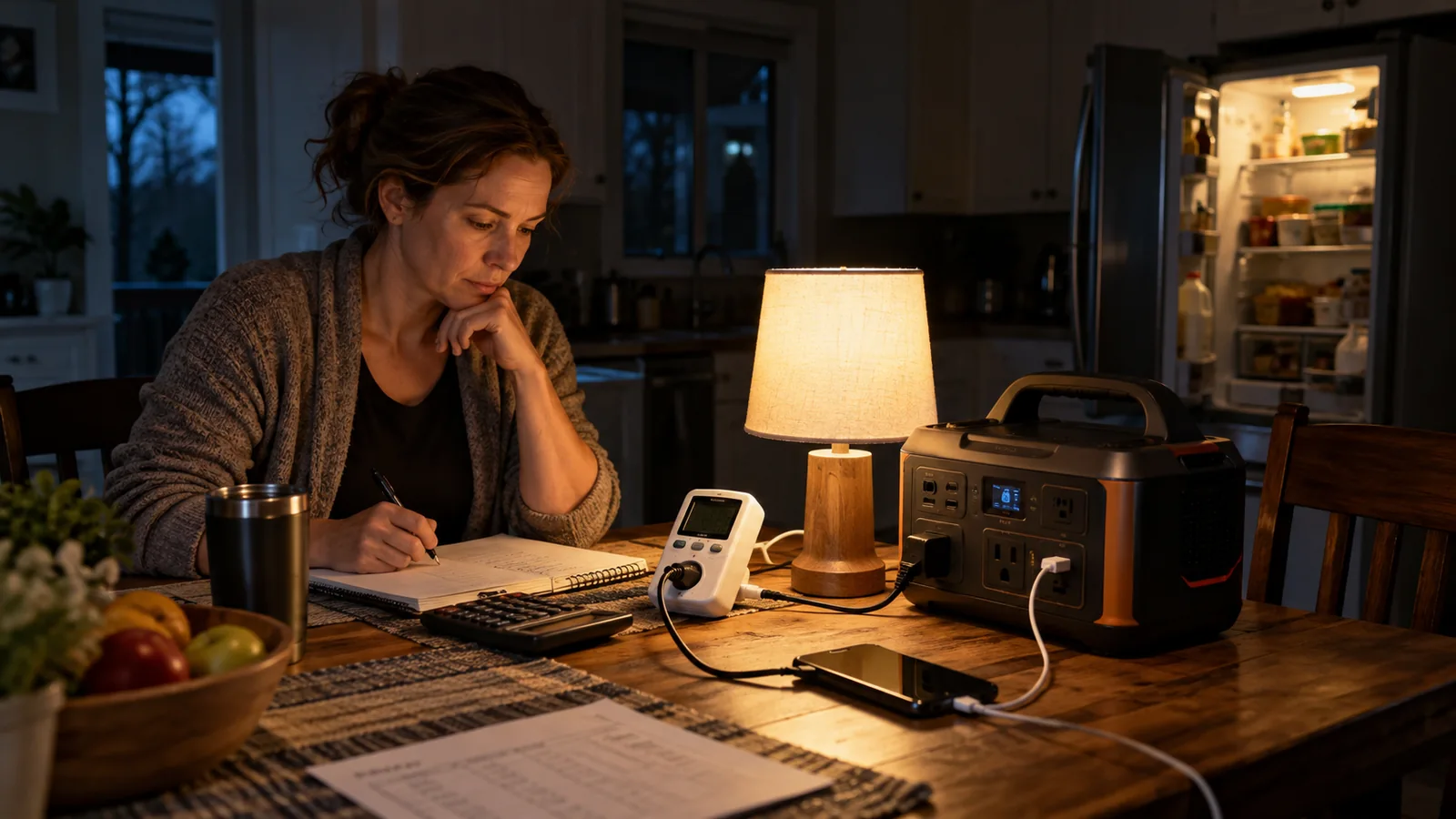
A generator can sit in your garage for three years, start perfectly on the first pull, and still be the wrong generator for your house. It might run the refrigerator and a few lights but shut down when the well pump starts. Or it might have plenty of power but no safe way to connect to the circuits you actually need.
That is the problem with shopping for emergency power by generator size alone. The real question is not, “How big a generator should I buy?” It is, “What must keep working, for how long, and how will I connect it safely?”
Answer those three questions before you spend a dollar. The rest gets much easier.
Start with the things you cannot afford to lose
Walk through your house and write down what a power outage would stop. Don't begin with every appliance you own. Begin with the consequences.
A refrigerator full of food is inconvenient to lose. A freezer full of meat is expensive to lose. But a powered medical device, a sump pump during heavy rain, or a well pump supplying your only source of water may be a more urgent priority. In a southern summer, loss of cooling can become a health problem. In a northern winter, loss of heat may threaten plumbing and people.
Make three columns on a sheet of paper: must run, nice to run, and can wait. A typical first column might include a refrigerator, one freezer, a few lights, phone chargers, internet equipment if service remains available, and any essential medical equipment. Well pumps, sump pumps, and heating-system controls belong there when your house depends on them.
Be specific. “Heat” could mean a small gas furnace blower, a heat pump with an electric backup strip, or portable electric heaters. Their power requirements are vastly different. A generator capable of running a furnace fan will not necessarily run electric resistance heat.
If the immediate problem is keeping refrigerated food safe, our guide to how long a portable power station can run a refrigerator covers that smaller job. Here we are making the household plan.
Write down running watts and starting watts
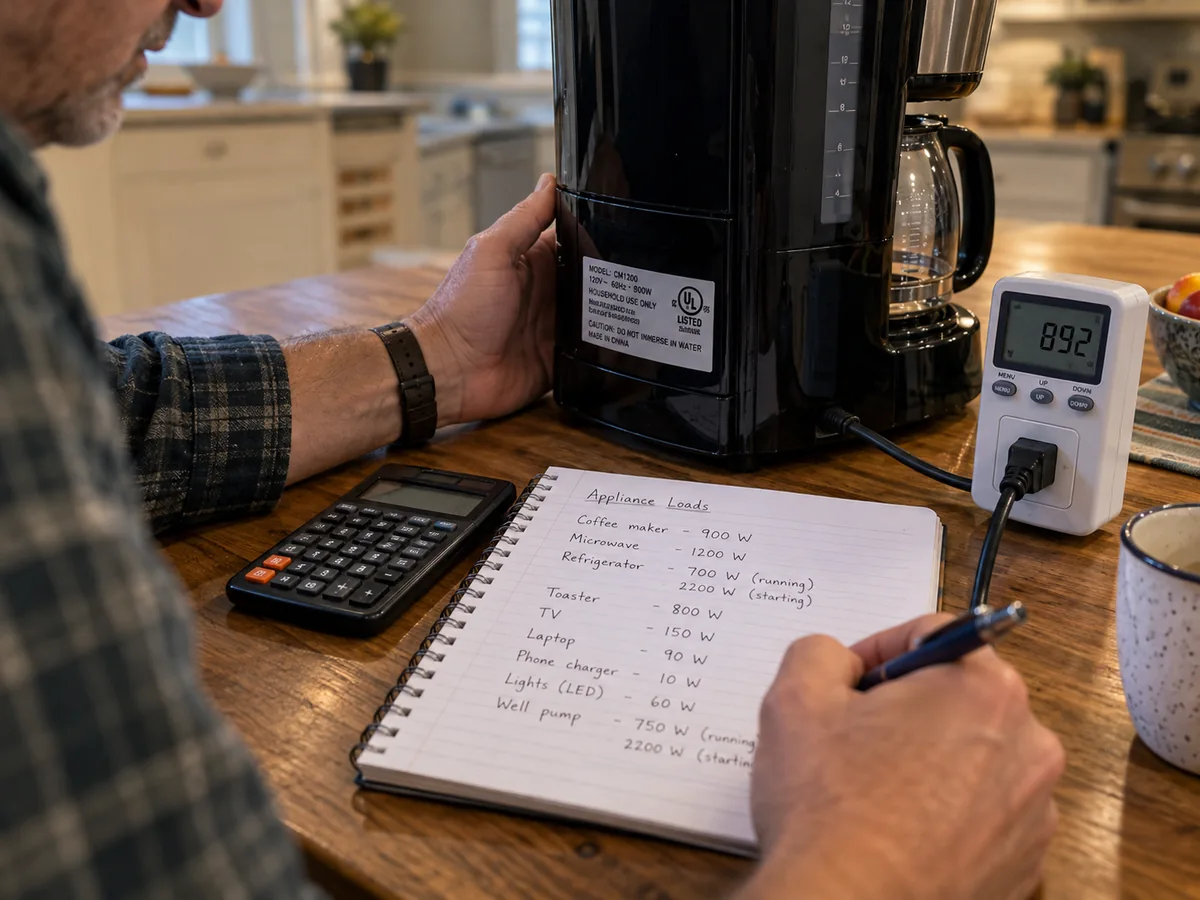
Every electrical load has a running demand, but some motors require a short burst of extra power to start. A refrigerator compressor, well pump, window air conditioner, and sump pump may all draw considerably more at startup than while running.
Find actual ratings on the appliance label, manual, or manufacturer data sheet. A watt meter can help measure certain plug-in devices. Equipment hardwired to the home, such as a well pump or HVAC system, may need an electrician to establish the real load and starting requirement.
Here's an illustration, not a shopping specification:
| Appliance | Example running watts | Possible startup issue |
|---|---|---|
| Refrigerator | 150 | Compressor surge |
| Chest freezer | 100 | Compressor surge |
| LED lighting in several rooms | 60 | Usually minor |
| Router and modem | 25 | Usually minor |
| Phone and device chargers | 40 | Usually minor |
| Furnace blower | 500 | Motor surge |
This example totals 875 running watts. That does not mean a 900-watt generator will operate it. The furnace blower or compressor may need more power for an instant, and the actual ratings might be much higher than the examples.
Do not simply add the starting wattage of every appliance as though all the motors must start simultaneously. Instead, estimate the largest credible overlapping demand and consider how equipment cycles automatically. A professional load calculation is especially worthwhile for pumps, HVAC, and whole-home connections.
Leave margin. Running a machine at its advertised maximum output for hours is not the same thing as operating comfortably within its continuous rating. And remember that a generator's advertised peak or surge number is different from its rated running output.
Decide whether you need outlets or house circuits
This is where many otherwise sensible plans fall apart.
For a few cord-connected appliances, a properly sized generator can supply power through suitable, intact, outdoor-rated extension cords. Keep cords protected from damage and sized for the load and distance. Do not run them under rugs, pinch them in doors, or create trip hazards in escape paths.
But imagine the things you need are on dedicated circuits: a well pump, furnace, garage refrigerator, or hardwired sump pump. You cannot solve that problem by dragging a cord across the kitchen floor.
For those loads, talk with a qualified electrician about a listed transfer switch, suitable interlock where permitted, proper inlet, grounding and bonding requirements, and a clearly defined set of backup circuits. The equipment must prevent generator power from flowing back onto utility lines.
Never plug a generator into a dryer receptacle or another household outlet to feed the panel. That shortcut can electrocute utility workers, damage equipment, and set up dangerous conditions when utility service returns.
A transfer setup is not a luxury upgrade. For household-circuit backup, it is part of the safety plan.
Portable generator, inverter generator, battery, or standby system?
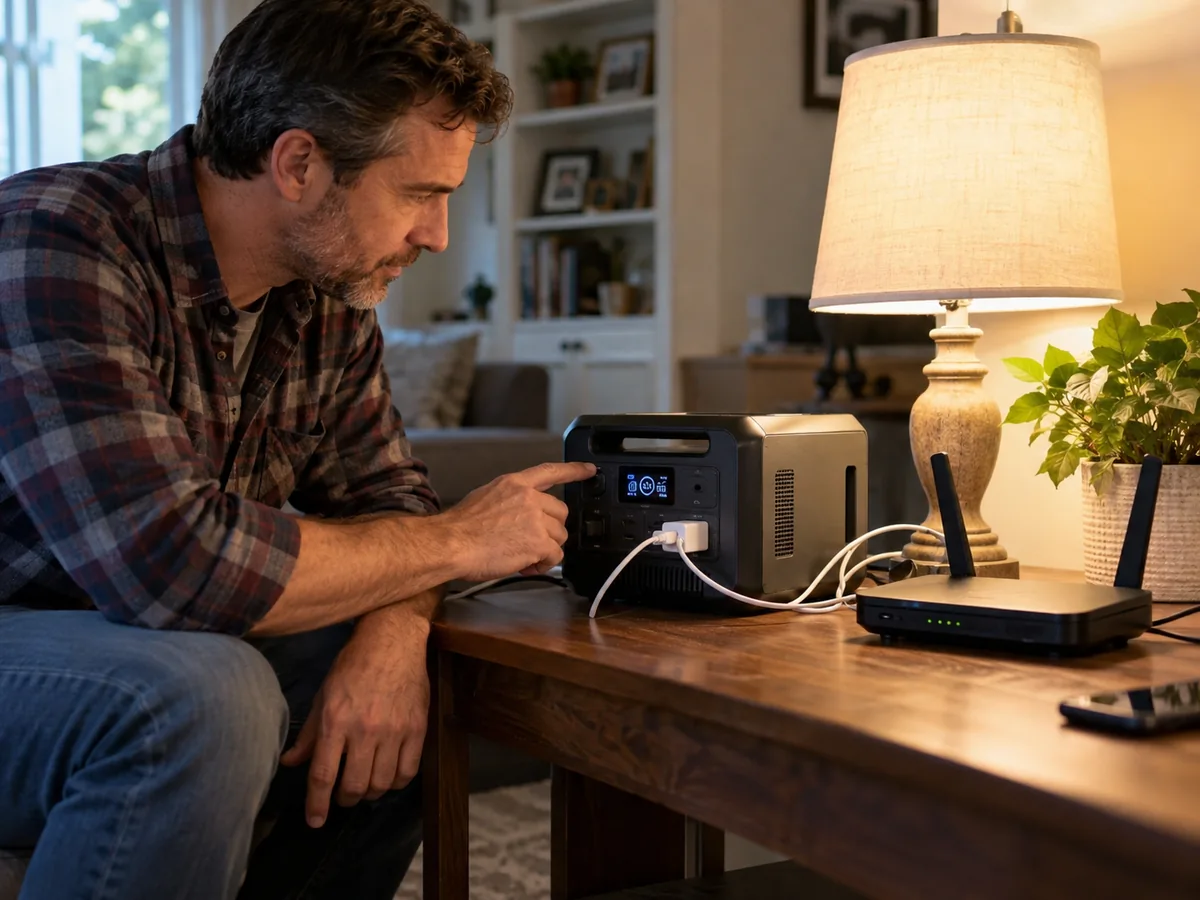
Each solves a slightly different problem.
A conventional portable generator is often an economical way to produce substantial power during a long outage. You supply and store fuel, move the unit outdoors, start it, maintain it, and manage noise. Some appliances may benefit from the more stable output of an inverter design.
An inverter generator can be quieter and more fuel-efficient at changing loads, but its size still must fit your actual starting requirements. “Inverter” does not magically make a small generator capable of starting a large air conditioner.
A battery power station is wonderfully convenient for smaller loads. It makes no exhaust while operating, can often be used inside according to manufacturer instructions, and requires no fuel handling. Its limitation is energy capacity: once the stored watt-hours are gone, you need another way to charge it. Large heaters, electric ovens, and whole-home air conditioning can drain a modest battery system quickly.
A permanently installed standby generator may automatically switch on, power selected circuits or a larger set of household loads, and run on an approved fuel supply. That convenience comes with higher purchase and installation costs, professional maintenance, and fuel-system dependencies.
Home battery systems can also be installed to support selected or whole-home circuits, depending on design and capacity. They may pair with solar, but not every rooftop solar system provides power when the grid goes down. Solar panels alone are not proof that your house will work during an outage. The inverter, transfer/islanding equipment, and battery configuration determine that.
You may decide the smartest arrangement is a modest generator plus a small battery station for overnight lighting and electronics. There is no award for buying one enormous box that does everything badly.
Calculate energy, not just power
Watts tell you how much power an appliance needs at a moment. Watt-hours describe how much energy it consumes over time.
The relationship is straightforward:
Watts × hours = watt-hours.
A 50-watt fan running eight hours consumes approximately 400 watt-hours. A 100-watt load running ten hours uses about 1,000 watt-hours, or 1 kilowatt-hour. Real-world battery runtime is shorter than a simple division may suggest because of conversion losses, standby consumption, temperature, and battery reserve limits.
Generators bring a different constraint. They can make electricity as long as they have suitable fuel and are functioning, but fuel use depends on the load. Find the manufacturer's published consumption figures for the output levels you expect. Estimate how many hours you truly plan to operate it each day rather than assuming it will run continuously.
You might run a refrigerator and freezer long enough to maintain safe temperatures, power a well pump to fill containers, and then shut down to conserve fuel. But do not assume a particular food-safe duty cycle without measuring temperatures. Keeping refrigerator and freezer doors closed helps, and a thermometer is more useful than guessing.
The dangerous part: where the generator runs
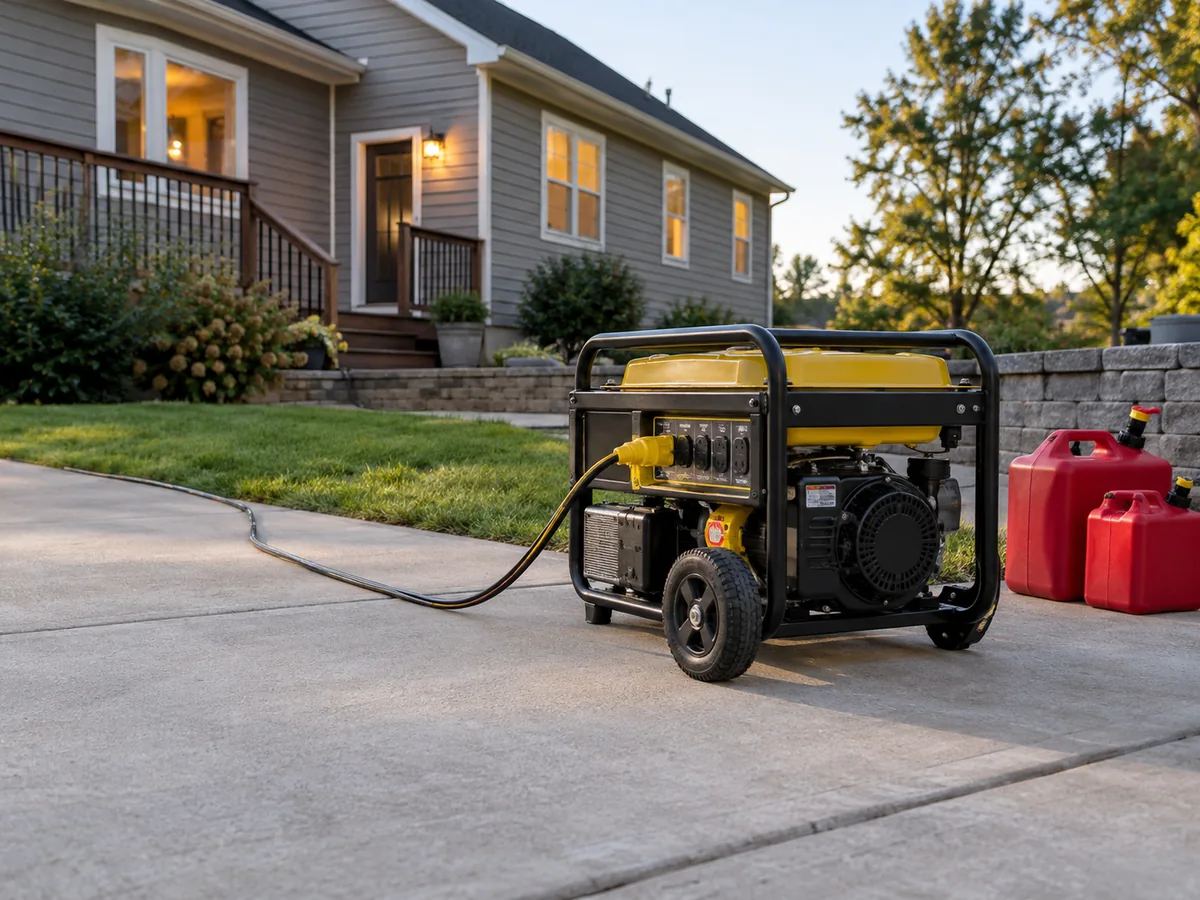
Portable fuel-burning generators produce carbon monoxide, an invisible gas that can kill people before they realize what is happening.
Operate a generator outdoors at least 20 feet from doors, windows, and vents, with the exhaust directed away from buildings. Never use one in a garage, even with the garage door open, a basement, porch enclosure, shed attached to the house, or near an open window. Follow manufacturer instructions and local requirements; some safety guidance recommends an even greater separation.
Keep the unit dry using manufacturer-approved protection that does not enclose or obstruct ventilation. Never operate or refuel it in standing water. Shut it off and let it cool before adding fuel, and store fuel only in approved containers, outside living spaces and away from ignition sources.
Have working carbon monoxide alarms in the home, including near sleeping areas, along with smoke alarms. Treat a sounding CO alarm or symptoms such as headache, dizziness, weakness, or nausea as a reason to get everyone into fresh air immediately and call emergency services. Do not go back inside until responders say it is safe.
If the weather makes outdoor generator operation unsafe, the answer is not to bring the generator inside. Use another method of backup power or go somewhere safe.
Air conditioners and electric heaters change the calculation
Wanting “a little cooling” is understandable during a summer outage. But a central air-conditioning system can have substantial running and startup needs, especially where electric resistance heating is involved. A small backup generator advertised as able to run several home appliances may still be nowhere close.
A correctly sized window air conditioner or small room unit can sometimes create one tolerable room with much less power than central cooling. Its actual electrical requirements still need checking. During heat emergencies, moving to an available cooling center may be safer than relying on a marginal setup.
Electric space heaters typically consume enough power to dominate a small generator's capacity. Never bring outdoor combustion heaters, charcoal, camp stoves, or grills into the house as substitutes. Our winter power-outage guide explains other ways to protect warmth without adding that risk.
Test the entire plan before the storm
A system you have never tried is a collection of assumptions.
On an ordinary day, review the owner's manuals, set up the generator in its safe operating location, verify the fuel and oil, and test the intended loads through the approved connection. Ask the electrician to show you exactly what your transfer equipment does. Label the circuits and leave written instructions for another adult in the household.
Start one motor load at a time and pay attention to overload indicators, unexpected breaker trips, and voltage problems. If a medical device relies on backup power, coordinate an appropriate backup plan with its manufacturer and medical team, including what to do if the system fails.
Check batteries, stored fuel condition, extension cords, CO alarms, and maintenance schedules periodically. A generator that ran beautifully years ago does not automatically remain ready today.
The right system is the one your household can actually operate
Build a one-page plan: the circuits you must protect, actual power demands, connection method, fuel or battery runtime, safe operating location, and the person who knows how to use it.
Then ask a practical question: Could another adult in this house make it work safely if I weren't home?
If the answer is no, you have found the next thing to fix. Emergency power is not about buying the biggest generator on the shelf. It's about keeping the essentials running without creating a second emergency.